D&D Dice Guide: A Comprehensive Overview (Updated 03/26/2026)
Dungeons & Dragons utilizes polyhedral dice for action resolution, encompassing sets with 4, 6, 8, 10, 12, and 20 sides․ This guide explores dice types, quality, probability, and mechanics․
Polyhedral dice are the cornerstone of the Dungeons & Dragons experience, moving beyond the standard six-sided die to introduce a fascinating array of shapes and probabilities․ Unlike traditional dice, these multi-faceted tools aren’t merely for board games; they’re integral to narrating stories, resolving conflicts, and determining the fate of adventurers within a fantastical realm․
The term “polyhedral” simply means “many-sided,” and in D&D, this translates to dice with 4, 6, 8, 10, 12, and 20 faces․ Each die serves a specific purpose, influencing everything from the damage inflicted by a weapon to the success of a crucial skill check․ Understanding these dice isn’t just about knowing how many sides they have; it’s about grasping the underlying mechanics that drive the game forward․
This guide will delve into the world of polyhedral dice, exploring their individual uses, the nuances of dice notation, and the importance of quality and probability․ Prepare to unlock the secrets behind these essential tools and elevate your D&D gameplay!
What are Polyhedral Dice?
Polyhedral dice represent a departure from the ubiquitous six-sided die, offering a wider spectrum of random outcomes crucial for the dynamic gameplay of Dungeons & Dragons․ These dice aren’t simply numbered cubes; they come in various geometric forms – tetrahedrons (d4), hexahedrons (d6), octahedrons (d8), decahedrons (d10), dodecahedrons (d12), and icosahedrons (d20) – each with a unique role․
The “d” prefix denotes “die,” while the number signifies the number of faces․ For instance, a d20 has twenty sides, numbered 1 through 20․ This variety allows for more nuanced probability distributions than a standard die, influencing everything from damage rolls to ability checks․ A d4 might represent the minimal damage of a dagger, while a d20 determines the success of a perilous quest․
Essentially, polyhedral dice are tools for introducing controlled randomness into the game, simulating the unpredictable nature of combat, exploration, and social interaction․ They are the engine that drives the narrative, ensuring that every session is a unique and engaging experience․
The Standard D&D Dice Set
A complete Dungeons & Dragons dice set comprises seven distinct polyhedral dice, each serving a specific purpose within the game’s mechanics․ This standard collection includes one d4, one d6, one d8, two d10s (one for percentile rolls), one d12, and one d20․ Having a full set ensures players are prepared for any situation the Dungeon Master throws their way․
The d20 is arguably the most iconic, used for ability checks, attack rolls, and saving throws – the core mechanics determining success or failure․ The d6 is frequently used for damage, alongside other dice depending on the weapon․ d4s represent smaller damage outputs, while d8s and d12s cover a wider range․ The two d10s combine to create a d100, used for percentile rolls, often determining random events or critical hit chances․
Investing in a quality set is crucial, as these dice will be used extensively throughout countless adventures․ Many players develop a fondness for their dice, considering them lucky charms or treasured possessions․
Understanding Dice Notation (e․g․, d20, 2d6)
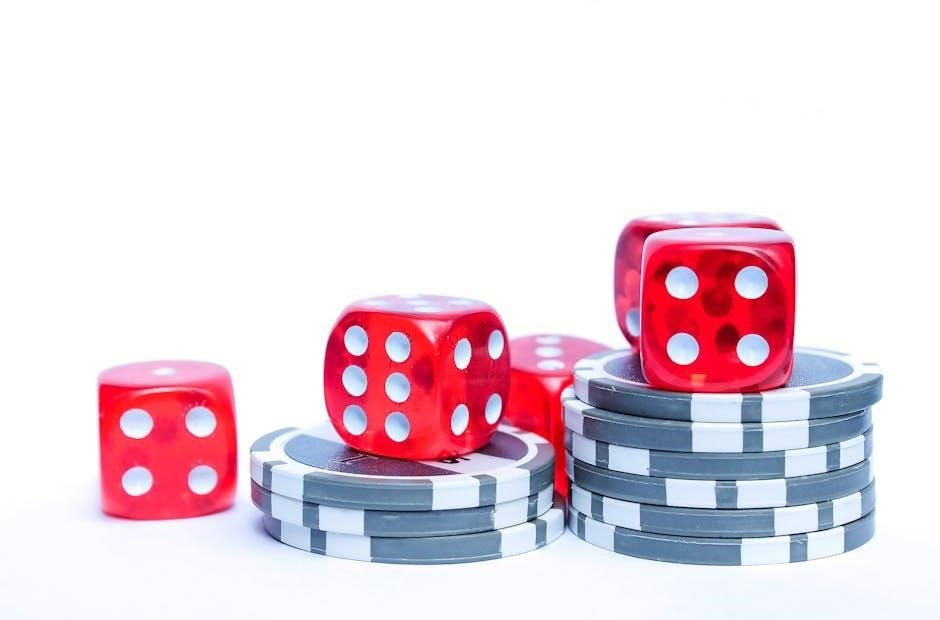
Dungeons & Dragons utilizes a concise notation system to represent dice rolls, streamlining communication and game mechanics․ The fundamental format is “dXy,” where ‘X’ denotes the number of dice to roll, and ‘Y’ specifies the number of sides on each die․ For instance, “d20” signifies rolling a single twenty-sided die, commonly used for ability checks and attack rolls․
When multiple dice are involved, the notation changes accordingly․ “2d6” instructs a player to roll two six-sided dice and sum the results, frequently employed for damage calculations․ Modifiers can be added after the dice notation, indicated by a plus (+) or minus (-) sign, representing bonuses or penalties․ For example, “2d6 + 3” means rolling two d6s and adding 3 to the total․
Understanding this notation is essential for interpreting character sheets, spell descriptions, and Dungeon Master instructions․ Mastering it allows for quick and accurate resolution of game actions, enhancing the overall gameplay experience․

Types of D&D Dice and Their Uses
D&D employs a variety of polyhedral dice – d4, d6, d8, d10, d12, and d20 – each serving unique purposes within the game, from damage to checks․
D4: Uses and Common Applications
The four-sided die, or d4, is a staple in Dungeons & Dragons, though perhaps the least frequently rolled compared to others․ Its primary application lies in representing smaller damage outputs, frequently associated with weapons like daggers or darts․ However, its utility extends beyond simple damage; it’s often used for spells with limited effects or for tracking minor conditions․
Due to its lower range (1-4), the d4 introduces a degree of unpredictability, even with modest rolls․ While it won’t deliver massive bursts of damage, it ensures that even weaker attacks have a chance to contribute meaningfully․ Players will encounter d4s in scenarios requiring small, incremental changes or when a limited range of results is desired․ It’s a foundational die, representing the potential for impactful, yet contained, outcomes within the game’s mechanics․ Its simplicity belies its importance in balancing combat and spellcasting․
D6: Versatility in Damage and Other Rolls
The six-sided die, or d6, stands out as arguably the most versatile die in the Dungeons & Dragons toolkit․ Beyond its common use for weapon damage – frequently seen with simpler melee weapons – the d6 finds application in a remarkably broad spectrum of game mechanics․ It’s a cornerstone for determining random effects, generating minor treasure values, and resolving various skill checks where a moderate range of outcomes is appropriate․
A key characteristic of the d6 is its tendency to produce results clustered around the middle values (3 and 4 are the most probable)․ This creates a bell-curve probability distribution, making it ideal for scenarios where consistency is desired․ Unlike the d20’s binary pass/fail nature, the d6 offers a more nuanced range of success․ Its widespread use reflects its ability to represent a balanced and predictable element of chance within the game, making it a truly essential component of any D&D experience․
D8: Common for Weapon Damage
The eight-sided die, commonly known as the d8, frequently appears when calculating weapon damage in Dungeons & Dragons․ It’s a staple for many martial weapons, offering a damage range that sits comfortably between the lower output of a d6 and the higher potential of a d10 or d12․ Weapons like longswords, battleaxes, and short swords often utilize a 1d8 for their base damage, providing a solid and reliable offensive capability for player characters․
Beyond simply determining damage, the d8’s eight sides contribute to a slightly wider probability distribution than a d6, introducing a bit more variance in combat outcomes․ While still favoring the middle values, the d8 allows for the possibility of both lower and higher damage rolls, adding a touch of unpredictability․ This makes it a balanced choice for weapons intended for consistent, yet not overwhelmingly powerful, attacks․ Its prevalence in weapon damage showcases its role in defining the core combat experience within the game․
D10: Percentile Dice and Hit Points
The ten-sided die, or d10, serves dual purposes in Dungeons & Dragons․ Primarily, it’s crucial for percentile rolls, achieved by using two d10s – one representing the tens digit and the other the ones․ This allows for a range of 1 to 100, used for random events, determining critical hit ranges, or resolving specific table results․ This system provides a broad spectrum for unpredictable outcomes, adding depth to gameplay․
Beyond percentile rolls, the d10 is also frequently employed for determining character hit points, particularly when using the hit dice method․ Certain classes might utilize a d10 as their hit die, influencing their character’s survivability․ The d10’s range offers a moderate increase in hit points per level, balancing resilience with other character attributes․ Its versatility makes it a fundamental component of character creation and progression, impacting both random events and core character statistics․
D12: Less Common, Specific Weapon Damage
The twelve-sided die, or d12, occupies a niche role within the standard Dungeons & Dragons dice set․ Unlike the frequently used d6 or d20, the d12 isn’t a staple for general checks or common damage calculations․ Instead, its primary application lies in determining the damage output of specific weapons․ Typically, heavier and more formidable weapons, like greatswords or mauls, are assigned damage dice of 2d6 or even a single d12․
This design choice reflects the weapon’s potential for significant, albeit less consistent, damage․ A d12 offers a wider range of possible results compared to smaller dice, representing the impactful blows these weapons can deliver․ While a d6 might provide more frequent, moderate damage, the d12 introduces the possibility of exceptionally high rolls․ Consequently, the d12’s presence signifies a weapon capable of changing the tide of battle with a single, powerful strike, making it a valuable, though specialized, component of a player’s arsenal․
D20: The Core of D&D Checks
The twenty-sided die, universally known as the d20, is arguably the most iconic and crucial component of the Dungeons & Dragons experience․ It serves as the foundation for the vast majority of checks, saving throws, and attack rolls within the game․ Its significance stems from its ability to provide a uniform probability distribution – each number from 1 to 20 has an equal 5% chance of being rolled․
This uniform probability is ideal for binary pass/fail scenarios․ When attempting an action, players roll a d20, add relevant modifiers, and compare the result to a target number (Difficulty Class or Armor Class)․ Success or failure hinges solely on exceeding this target․ The d20’s simplicity and fairness make it the perfect tool for resolving uncertainty and introducing an element of chance․ It’s the die that determines whether a hero succeeds in scaling a wall, persuading a guard, or landing a critical blow, solidifying its central role in gameplay․

Dice Quality and Materials
Dice quality varies; transparent/translucent sets allow for imperfection checks․ Opaque dice may contain flaws like air bubbles or uneven weight distribution, impacting rolls and fairness․
Transparent vs․ Opaque Dice: Quality Control
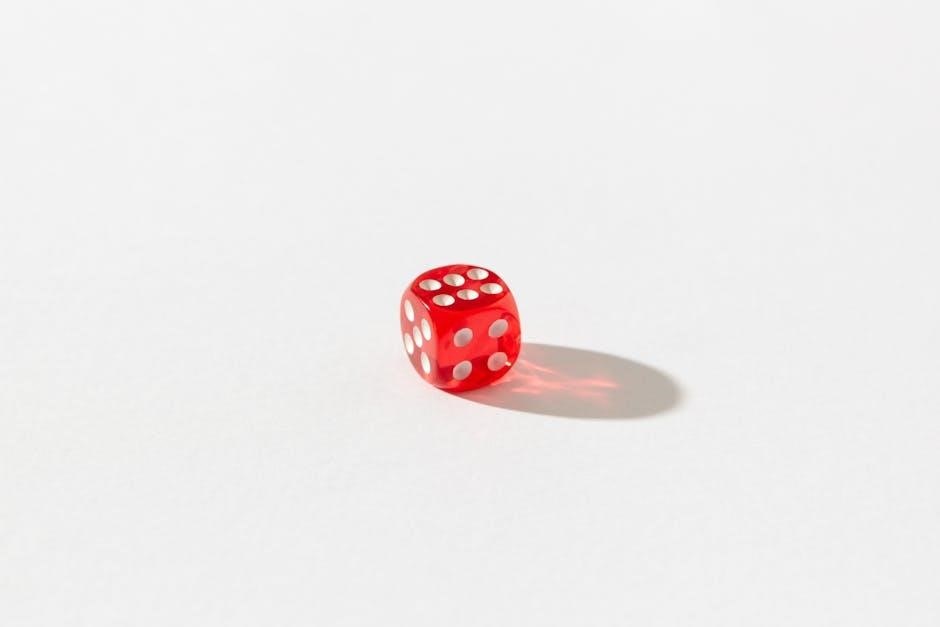
When considering D&D dice, the visibility of internal flaws becomes a crucial quality control factor․ Transparent or translucent dice offer a distinct advantage: players can visually inspect them for imperfections before use․ This simple check allows for the identification of air bubbles, swirling color inconsistencies, or material defects that could potentially skew results․
Opaque dice, conversely, conceal these flaws․ While not inherently bad, they remove the player’s ability to proactively assess the dice’s integrity․ Manufacturing imperfections, such as uneven powder mixing or filler material, are more likely to go unnoticed․ Multicolored swirl dice are particularly susceptible to weight imbalances due to differing densities of the incorporated colors․
Essentially, transparency provides a form of self-regulation․ Being able to see through the dice empowers players to ensure a fairer gaming experience․ Accreditation and price aren’t always reliable indicators of quality; visual inspection offers a direct assessment of the product’s physical condition․
The Impact of Imperfections on Dice Rolls
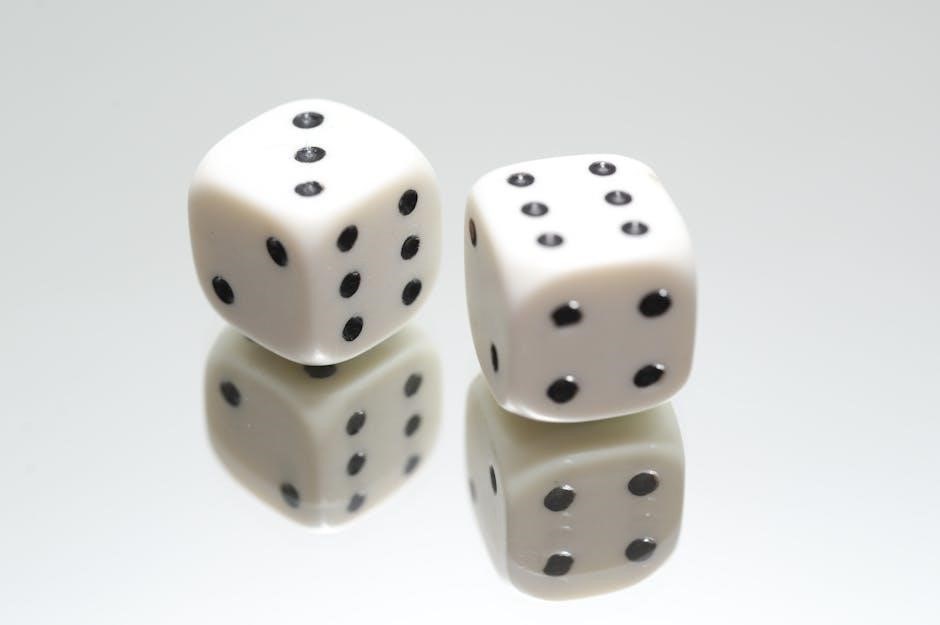
Even seemingly minor imperfections within D&D dice can subtly influence the outcome of rolls․ Air bubbles trapped during manufacturing, uneven material distribution, or slight weight imbalances can all contribute to non-random results․ These flaws disrupt the ideal of uniform probability, where each face has an equal chance of landing face up․
Defective dice, often created using flawed filler material, are particularly problematic․ Imperfections can cause the dice to favor certain numbers, leading to skewed distributions over time․ While a single flawed roll might seem insignificant, the cumulative effect across numerous games can noticeably alter the statistical landscape․
The impact isn’t always dramatic, but it’s enough to introduce a degree of unpredictability beyond the intended randomness․ Players seeking consistently fair results should prioritize high-quality dice and actively inspect them for visible defects․ Transparency allows for this crucial quality check, mitigating the risk of biased outcomes․
Metal Dice: Considerations and Drawbacks
Metal D&D dice offer a premium aesthetic and satisfying weight, appealing to many players․ However, their use isn’t without considerations․ The increased density compared to plastic can lead to greater wear and tear on gaming surfaces, potentially scratching tables or damaging delicate game mats․ This is a significant drawback for those prioritizing surface protection․
Furthermore, the manufacturing process for metal dice can introduce inconsistencies in balance․ While high-quality sets strive for precision, achieving perfectly uniform weight distribution across all faces is challenging․ This can subtly affect roll outcomes, deviating from the ideal of uniform probability․
Cost is another factor; metal dice are considerably more expensive than their plastic counterparts․ Given the potential for imperfections and surface damage, the added expense may not be justified for all players․ Ultimately, the decision to use metal dice hinges on a balance between aesthetic preference, budget, and risk tolerance․
Accreditation and Price: What Matters Most
When selecting D&D dice, the relationship between accreditation and price is crucial․ While expensive dice aren’t automatically superior, a lack of quality control can lead to flawed results․ Accreditation, though not always present, signifies a degree of testing and adherence to standards, offering more reassurance than simply a high price tag․
Focusing solely on cost can be misleading․ Defective dice, often used as filler in cheaper sets, may contain imperfections like air bubbles or uneven weight distribution, impacting roll fairness․ Transparent or translucent dice allow visual inspection for these flaws, acting as a form of self-accreditation․
Prioritize sets from reputable manufacturers who demonstrate a commitment to quality, even if they aren’t formally accredited․ A reasonable price point combined with positive reviews and visible transparency is often a better indicator of value than a premium brand name alone․ Ultimately, informed purchasing is key․

Dice Probability and Mechanics
D&D employs both linear probabilities, like a d20 against a target, and bell-curve probabilities from adding multiple dice, influencing damage consistency and overall game balance․

Uniform Probability: The d20 Example
The twenty-sided die, or d20, stands as a cornerstone of Dungeons & Dragons, primarily due to its embodiment of uniform probability․ This means each of the twenty possible outcomes – the numbers one through twenty – possesses an equal likelihood of being rolled․ Specifically, each number has a precisely one-in-twenty (1/20), or 5%, chance of appearing on any given roll․
This characteristic makes the d20 ideally suited for binary pass/fail checks, such as skill checks, saving throws, and attack rolls․ The simplicity of equal odds allows for straightforward determination of success or failure based on a predetermined target number․ Unlike dice that produce bell-curve distributions, the d20 doesn’t favor any particular result․
Because of this even distribution, players can readily understand the inherent risk and reward associated with each attempt․ The d20’s uniform probability provides a clear and predictable foundation for many of the game’s core mechanics, ensuring fairness and transparency in resolving actions․
Linear Probabilities vs․ Bell-Curve Probabilities
Dungeons & Dragons employs both linear probabilities and bell-curve probabilities, each serving distinct purposes within the game’s mechanics․ Linear probabilities, exemplified by the d20, involve a fixed chance for each outcome – a straight line when graphed․ Success is determined by exceeding a target number, offering a consistent risk assessment․
Conversely, bell-curve probabilities arise when multiple dice are added together, like rolling 2d6․ This creates a distribution where middle results are more frequent, forming a bell-shaped curve․ A roll of 7 with 2d6 is the most common outcome, while extreme values (2 or 12) are rarer․

This difference dictates their application․ Linear probabilities suit checks needing clear pass/fail resolution, while bell-curve probabilities are better for damage rolls, where consistent, moderate results are often desired․ The 2d6 roll’s tendency towards the average provides a more predictable damage output compared to a single, higher-variance die․
Calculating Dice Probability: Tools and Methods
Determining the probability of specific dice roll outcomes can be complex, especially with multiple dice or modifiers․ Fortunately, numerous tools and methods simplify this process․ Online dice probability calculators allow users to input dice type (d4, d6, d8, d10, d12, d20, d100), the number of dice rolled, any applicable modifiers, and a target number․
These calculators instantly display the exact success chance, expressed as a percentage, alongside the odds ratio (e․g․, 1 in X)․ Manual calculation involves listing all possible outcomes and counting those that meet the criteria, then dividing by the total number of outcomes․
For example, with 2d6, there are 36 possible combinations․ To find the probability of rolling a 7 or higher, you’d count the combinations that sum to 7 or more and divide by 36․ Utilizing these tools or methods empowers players and Dungeon Masters to understand the likelihood of success in various game scenarios․
Advantage and Disadvantage: Modifying Probability
Dungeons & Dragons introduces advantage and disadvantage as mechanics to significantly alter the probability of success on a d20 roll․ When a character has advantage, they roll the d20 twice and take the higher result․ Conversely, disadvantage prompts rolling twice and selecting the lower outcome․
These mechanics don’t simply double the chances; they fundamentally shift the probability distribution․ Advantage substantially increases the likelihood of achieving a high roll, while disadvantage dramatically lowers it․ Rolling a 20 becomes nearly double with advantage, making critical hits more frequent․
Conversely, disadvantage makes rolling a 1 more likely․ These systems move away from the uniform probability of a single d20 roll, introducing a strategic layer where circumstances can heavily influence outcomes․ Understanding these probability shifts is crucial for both players and Dungeon Masters when assessing risk and reward․
Critical Hits: Probability and Weapon Choice
Critical hits in Dungeons & Dragons occur when a natural 20 is rolled on a d20 attack roll, automatically maximizing damage․ However, the probability of achieving a critical hit is intrinsically linked to weapon choice and modifiers like advantage․ While a standard d20 has a 5% chance for a critical hit, advantage significantly boosts this probability, nearly doubling it․
Interestingly, some players favor weapons with lower damage dice (like daggers) precisely because of critical hit potential․ A dagger’s smaller size allows for precise strikes, conceptually increasing the chance of a critical hit, even if the base damage is lower․ Conversely, heavier weapons like great axes offer consistent damage but don’t inherently improve critical hit odds․
This creates a fascinating risk-reward dynamic․ Choosing a dagger prioritizes the possibility of a devastating critical hit, while a great axe focuses on reliable, albeit less spectacular, damage output․ Understanding these probabilities informs strategic weapon selection․